a metallic coin is given a positive electric charge. what happens to its mass
| Electric charge | |
|---|---|
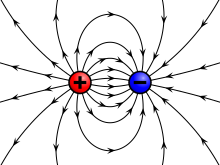 Electric field of a positive and a negative signal charge | |
| Common symbols | q |
| SI unit of measurement | coulomb |
| Other units |
|
| In SI base units | C = A⋅s |
| All-encompassing? | yes |
| Conserved? | yes |
| Dimension | |

Electric accuse is the physical holding of matter that causes it to feel a force when placed in an electromagnetic field. Electric accuse tin be positive or negative (unremarkably carried past protons and electrons respectively). Similar charges repel each other and unlike charges attract each other. An object with an absenteeism of internet accuse is referred to as neutral. Early on knowledge of how charged substances interact is now called classical electrodynamics, and is all the same accurate for bug that do non require consideration of quantum effects.
Electrical charge is a conserved property; the cyberspace charge of an isolated system, the amount of positive accuse minus the amount of negative charge, cannot change. Electric charge is carried by subatomic particles. In ordinary matter, negative charge is carried past electrons, and positive charge is carried by the protons in the nuclei of atoms. If in that location are more than electrons than protons in a piece of matter, it will have a negative charge, if in that location are fewer it volition accept a positive charge, and if there are equal numbers it will be neutral. Charge is quantized; it comes in integer multiples of individual small units called the unproblematic charge, east, virtually 1.602×10⁻¹⁹ coulombs,[i] which is the smallest accuse which can exist freely (particles called quarks have smaller charges, multiples of 1 / 3 eastward, but they are only found in combination, and always combine to form particles with integer charge). The proton has a accuse of +e, and the electron has a charge of −eastward.
Electric charges produce electric fields.[2] A moving charge also produces a magnetic field.[3] The interaction of electric charges with an electromagnetic field (combination of electric and magnetic fields) is the source of the electromagnetic (or Lorentz) strength,[4] which is 1 of the 4 fundamental forces in physics. The study of photon-mediated interactions among charged particles is called breakthrough electrodynamics.[5]
The SI derived unit of electric accuse is the coulomb (C) named after French physicist Charles-Augustin de Coulomb. In electrical engineering it is also mutual to use the ampere-hour (Ah). In physics and chemical science it is mutual to utilize the elementary charge (e) as a unit. Chemical science also uses the Faraday constant as the charge on a mole of electrons. The lowercase symbol q often denotes charge.
Overview [edit]
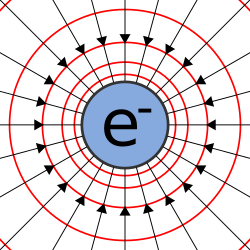
Diagram showing field lines and equipotentials around an electron, a negatively charged particle. In an electrically neutral atom, the number of electrons is equal to the number of protons (which are positively charged), resulting in a net zero overall charge
Charge is the fundamental holding of matter that exhibit electrostatic allure or repulsion in the presence of other thing with charge. Electrical charge is a characteristic property of many subatomic particles. The charges of complimentary-continuing particles are integer multiples of the elementary charge e; we say that electric charge is quantized. Michael Faraday, in his electrolysis experiments, was the first to note the discrete nature of electric charge. Robert Millikan's oil drop experiment demonstrated this fact directly, and measured the elementary accuse. It has been discovered that one type of particle, quarks, accept partial charges of either − 1 / three or + 2 / 3 , but it is believed they always occur in multiples of integral accuse; free-continuing quarks have never been observed.
By convention, the charge of an electron is negative, −e, while that of a proton is positive, +eastward. Charged particles whose charges have the aforementioned sign repel one another, and particles whose charges have different signs concenter. Coulomb's constabulary quantifies the electrostatic force between ii particles by asserting that the force is proportional to the product of their charges, and inversely proportional to the square of the distance between them. The accuse of an antiparticle equals that of the respective particle, just with opposite sign.
The electric charge of a macroscopic object is the sum of the electric charges of the particles that brand it up. This accuse is often small, because thing is made of atoms, and atoms typically have equal numbers of protons and electrons, in which case their charges cancel out, yielding a net charge of zip, thus making the atom neutral.
An ion is an atom (or group of atoms) that has lost one or more than electrons, giving it a internet positive charge (cation), or that has gained ane or more electrons, giving it a net negative charge (anion). Monatomic ions are formed from single atoms, while polyatomic ions are formed from two or more atoms that have been bonded together, in each case yielding an ion with a positive or negative net charge.

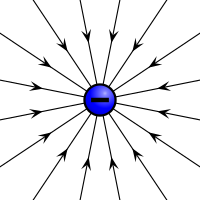
Electric field induced by a positive electric charge (left) and a field induced by a negative electrical charge (right).
During the formation of macroscopic objects, elective atoms and ions usually combine to form structures equanimous of neutral ionic compounds electrically bound to neutral atoms. Thus macroscopic objects tend toward being neutral overall, but macroscopic objects are rarely perfectly net neutral.
Sometimes macroscopic objects contain ions distributed throughout the material, rigidly bound in place, giving an overall net positive or negative charge to the object. Likewise, macroscopic objects made of conductive elements tin can more or less hands (depending on the chemical element) take on or give off electrons, and and so maintain a net negative or positive charge indefinitely. When the cyberspace electrical charge of an object is not-zero and motionless, the phenomenon is known equally static electricity. This can easily be produced by rubbing two dissimilar materials together, such as rubbing bister with fur or glass with silk. In this way, non-conductive materials can be charged to a significant degree, either positively or negatively. Accuse taken from ane material is moved to the other material, leaving an contrary charge of the same magnitude backside. The law of conservation of charge always applies, giving the object from which a negative accuse is taken a positive charge of the same magnitude, and vice versa.
Fifty-fifty when an object'southward net charge is zippo, the charge tin be distributed not-uniformly in the object (e.m., due to an external electromagnetic field, or bound polar molecules). In such cases, the object is said to exist polarized. The charge due to polarization is known equally bound charge, while the accuse on an object produced by electrons gained or lost from exterior the object is called complimentary charge. The motion of electrons in conductive metals in a specific direction is known every bit electric current.
Units [edit]
The SI derived unit of quantity of electric charge is the coulomb (symbol: C). The coulomb is divers as the quantity of charge that passes through the cantankerous section of an electric conductor carrying i ampere for 1 second.[half dozen] This unit was proposed in 1946 and ratified in 1948.[half dozen] In modern practise, the phrase "amount of charge" is used instead of "quantity of charge".[7] The lowercase symbol q is often used to denote a quantity of electricity or charge. The quantity of electric charge can be directly measured with an electrometer, or indirectly measured with a ballistic galvanometer.
The amount of charge in 1 electron (uncomplicated charge) is defined as a fundamental abiding in the SI system of units, (effective from 20 May 2019).[8] The value for elementary accuse, when expressed in the SI unit for electric charge (coulomb), is exactly 1.602176 634 ×x−xix C [1].[8]
After finding the quantized grapheme of charge, in 1891 George Stoney proposed the unit 'electron' for this cardinal unit of electrical charge. This was before the discovery of the particle by J. J. Thomson in 1897. The unit is today referred to as elementary charge, fundamental unit of accuse, or simply as due east. A mensurate of charge should exist a multiple of the elementary accuse e, even if at large scales charge seems to behave as a real quantity. In some contexts information technology is meaningful to speak of fractions of a accuse; for example in the charging of a capacitor, or in the fractional breakthrough Hall event.
The unit faraday is sometimes used in electrochemistry. One faraday of charge is the magnitude of the charge of one mole of electrons,[nine] i.e. 96485.33289(59) C.
In systems of units other than SI such as cgs, electric accuse is expressed as combination of just iii cardinal quantities (length, mass, and time), and not four, equally in SI, where electric charge is a combination of length, mass, time, and electric current.[ten] [11]
History [edit]

From ancient times, people were familiar with four types of phenomena that today would all be explained using the concept of electric accuse: (a) lightning, (b) the torpedo fish (or electric ray), (c) St Elmo'southward Burn, and (d) that bister rubbed with fur would attract small, low-cal objects.[12] The starting time account of the amber effect is often attributed to the ancient Greek mathematician Thales of Miletus, who lived from c. 624 – c. 546 BC, just at that place are doubts about whether Thales left any writings;[13] his account about amber is known from an business relationship from early 200s.[14] This business relationship can exist taken as evidence that the phenomenon was known since at least c. 600 BC, only Thales explained this miracle as evidence for inanimate objects having a soul.[xiv] In other words, there was no indication of whatever conception of electrical charge. More generally, the ancient Greeks did non understand the connections among these four kinds of phenomena. The Greeks observed that the charged bister buttons could attract low-cal objects such as hair. They also found that if they rubbed the amber for long enough, they could even get an electric spark to jump,[ commendation needed ] merely there is also a merits that no mention of electric sparks appeared until late 17th century.[xv] This holding derives from the triboelectric effect. In late 1100s, the substance jet, a compacted course of coal, was noted to have an amber upshot,[16] and in the eye of the 1500s, Girolamo Fracastoro, discovered that diamond also showed this event.[17] Some efforts were made by Fracastoro and others, especially Gerolamo Cardano to develop explanations for this phenomenon.[18]
In contrast to astronomy, mechanics, and optics, which had been studied quantitatively since antiquity, the starting time of ongoing qualitative and quantitative research into electrical phenomena can exist marked with the publication of De Magnete by the English scientist William Gilbert in 1600.[19] In this book, at that place was a small section where Gilbert returned to the amber effect (as he called it) in addressing many of the earlier theories,[eighteen] and coined the New Latin word electrica (from ἤλεκτρον (ēlektron), the Greek discussion for amber). The Latin word was translated into English language as electrics.[20] Gilbert is besides credited with the term electrical, while the term electricity came subsequently, first attributed to Sir Thomas Browne in his Pseudodoxia Epidemica from 1646.[21] (For more linguistic details see Etymology of electricity.) Gilbert hypothesized that this amber effect could be explained by an fetor (a small stream of particles that flows from the electric object, without diminishing its bulk or weight) that acts on other objects. This idea of a material electrical effluvium was influential in the 17th and 18th centuries. It was a precursor to ideas adult in the 18th century about "electrical fluid" (Dufay, Nollet, Franklin) and "electric charge".[22]
Effectually 1663 Otto von Guericke invented what was probably the first electrostatic generator, but he did not recognize it primarily as an electrical device and simply conducted minimal electrical experiments with it.[23] Other European pioneers were Robert Boyle, who in 1675 published the outset volume in English that was devoted solely to electrical phenomena.[24] His piece of work was largely a repetition of Gilbert's studies, merely he besides identified several more "electrics",[25] and noted common allure between two bodies.[24]
In 1729 Stephen Grey was experimenting with static electricity, which he generated using a glass tube. He noticed that a cork, used to protect the tube from dust and moisture, besides became electrified (charged). Further experiments (e.m., extending the cork past putting sparse sticks into information technology) showed—for the outset time—that electrical effluvia (as Greyness chosen it) could be transmitted (conducted) over a distance. Grayness managed to transmit charge with twine (765 anxiety) and wire (865 anxiety).[26] Through these experiments, Gray discovered the importance of dissimilar materials, which facilitated or hindered the conduction of electric effluvia. John Theophilus Desaguliers, who repeated many of Grayness's experiments, is credited with coining the terms conductors and insulators to refer to the effects of different materials in these experiments.[26] Gray too discovered electric induction (i.due east., where accuse could be transmitted from ane object to another without any direct physical contact). For example, he showed that past bringing a charged drinking glass tube close to, just not touching, a lump of atomic number 82 that was sustained past a thread, information technology was possible to make the pb become electrified (e.m., to attract and repel brass filings).[27] He attempted to explicate this phenomenon with the idea of electric effluvia.[28]
Gray's discoveries introduced an important shift in the historical development of knowledge about electric accuse. The fact that electric effluvia could be transferred from ane object to another, opened the theoretical possibility that this belongings was not inseparably connected to the bodies that were electrified by rubbing.[29] In 1733 Charles François de Cisternay du Fay, inspired past Grey's work, made a series of experiments (reported in Mémoires de l'Académie Royale des Sciences), showing that more or less all substances could be 'electrified' past rubbing, except for metals and fluids[xxx] and proposed that electricity comes in two varieties that cancel each other, which he expressed in terms of a 2-fluid theory.[31] When glass was rubbed with silk, du Fay said that the glass was charged with vitreous electricity, and, when amber was rubbed with fur, the bister was charged with resinous electricity. In contemporary understanding, positive charge is at present defined as the accuse of a glass rod afterward beingness rubbed with a silk cloth, but it is capricious which type of charge is called positive and which is called negative.[32] Another important two-fluid theory from this time was proposed past Jean-Antoine Nollet (1745).[33]
Up until nearly 1745, the principal explanation for electric attraction and repulsion was the idea that electrified bodies gave off an effluvium.[34] Benjamin Franklin started electric experiments in tardily 1746,[35] and by 1750 had developed a one-fluid theory of electricity, based on an experiment that showed that a rubbed glass received the same, only opposite, charge force as the fabric used to rub the drinking glass.[35] [36] Franklin imagined electricity as being a type of invisible fluid present in all thing; for example, he believed that it was the glass in a Leyden jar that held the accumulated charge. He posited that rubbing insulating surfaces together caused this fluid to modify location, and that a flow of this fluid constitutes an electrical current. He also posited that when matter contained an backlog of the fluid information technology was positively charged and when it had a deficit information technology was negatively charged. He identified the term positive with vitreous electricity and negative with resinous electricity after performing an experiment with a glass tube he had received from his overseas colleague Peter Collinson. The experiment had participant A accuse the drinking glass tube and participant B receive a shock to the knuckle from the charged tube. Franklin identified participant B to exist positively charged afterwards having been shocked by the tube.[37] In that location is some ambiguity nigh whether William Watson independently arrived at the same ane-fluid explanation around the same time (1747). Watson, after seeing Franklin's letter to Collinson, claims that he had presented the same caption equally Franklin in leap 1747.[38] Franklin had studied some of Watson'south works prior to making his ain experiments and analysis, which was probably significant for Franklin'due south own theorizing.[39] One physicist suggests that Watson first proposed a ane-fluid theory, which Franklin so elaborated further and more influentially.[forty] A historian of scientific discipline argues that Watson missed a subtle difference between his ideas and Franklin's, and then that Watson misinterpreted his ideas as existence similar to Franklin's.[41] In any case, in that location was no antagonism between Watson and Franklin, and the Franklin model of electrical action, formulated in early on 1747, somewhen became widely accepted at that time.[39] After Franklin'due south piece of work, effluvia-based explanations were rarely put frontwards.[42]
It is at present known that the Franklin model was fundamentally correct. There is only one kind of electric accuse, and merely ane variable is required to keep track of the amount of charge.[43]
Until 1800 it was only possible to study conduction of electric accuse by using an electrostatic discharge. In 1800 Alessandro Volta was the first to show that charge could be maintained in continuous motility through a closed path.[44]
In 1833, Michael Faraday sought to remove whatsoever doubt that electricity is identical, regardless of the source by which it is produced.[45] He discussed a variety of known forms, which he characterized every bit common electricity (east.thousand., static electricity, piezoelectricity, magnetic consecration), voltaic electricity (e.g., electrical current from a voltaic pile), and beast electricity (e.thou., bioelectricity).
In 1838, Faraday raised a question about whether electricity was a fluid or fluids or a property of thing, similar gravity. He investigated whether affair could be charged with one kind of charge independently of the other.[46] He came to the decision that electrical accuse was a relation betwixt two or more bodies, because he could not charge ane body without having an opposite charge in another body.[47]
In 1838, Faraday also put along a theoretical explanation of electric forcefulness, while expressing neutrality about whether it originates from 1, two, or no fluids.[48] He focused on the idea that the normal state of particles is to be nonpolarized, and that when polarized, they seek to return to their natural, nonpolarized state.
In developing a field theory approach to electrodynamics (starting in the mid-1850s), James Clerk Maxwell stops considering electrical charge as a special substance that accumulates in objects, and starts to sympathize electric charge equally a event of the transformation of free energy in the field.[49] This pre-quantum agreement considered magnitude of electric charge to be a continuous quantity, fifty-fifty at the microscopic level.[49]
The role of charge in static electricity [edit]
Static electricity refers to the electric charge of an object and the related electrostatic discharge when two objects are brought together that are not at equilibrium. An electrostatic discharge creates a modify in the charge of each of the ii objects.
Electrification by friction [edit]
When a piece of glass and a piece of resin—neither of which exhibit any electric backdrop—are rubbed together and left with the rubbed surfaces in contact, they even so exhibit no electric backdrop. When separated, they attract each other.
A second piece of glass rubbed with a second piece of resin, then separated and suspended near the former pieces of drinking glass and resin causes these phenomena:
- The two pieces of glass repel each other.
- Each piece of glass attracts each piece of resin.
- The two pieces of resin repel each other.
This attraction and repulsion is an electrical phenomenon, and the bodies that exhibit them are said to be electrified, or electrically charged. Bodies may exist electrified in many other ways, as well as by friction. The electrical properties of the two pieces of glass are like to each other but opposite to those of the two pieces of resin: The glass attracts what the resin repels and repels what the resin attracts.
If a trunk electrified in whatsoever manner whatsoever behaves as the glass does, that is, if it repels the drinking glass and attracts the resin, the body is said to be vitreously electrified, and if it attracts the drinking glass and repels the resin it is said to be resinously electrified. All electrified bodies are either vitreously or resinously electrified.
An established convention in the scientific customs defines vitreous electrification as positive, and resinous electrification as negative. The exactly reverse properties of the ii kinds of electrification justify our indicating them past opposite signs, but the application of the positive sign to ane rather than to the other kind must be considered as a affair of arbitrary convention—just as it is a matter of convention in mathematical diagram to reckon positive distances towards the right manus.
No forcefulness, either of attraction or of repulsion, tin exist observed betwixt an electrified body and a body not electrified.[50]
The role of charge in electric current [edit]
Electric current is the flow of electric accuse through an object. The nigh common accuse carriers are the positively charged proton and the negatively charged electron. The movement of any of these charged particles constitutes an electrical current. In many situations, it suffices to speak of the conventional current without regard to whether it is carried past positive charges moving in the direction of the conventional current or by negative charges moving in the opposite direction. This macroscopic viewpoint is an approximation that simplifies electromagnetic concepts and calculations.
At the opposite extreme, if 1 looks at the microscopic state of affairs, 1 sees in that location are many ways of carrying an electric current, including: a flow of electrons; a flow of electron holes that deed like positive particles; and both negative and positive particles (ions or other charged particles) flowing in opposite directions in an electrolytic solution or a plasma.
Beware that, in the mutual and important case of metallic wires, the management of the conventional electric current is opposite to the drift velocity of the actual charge carriers; i.e., the electrons. This is a source of confusion for beginners.
Conservation of electric charge [edit]
The total electric charge of an isolated organisation remains abiding regardless of changes inside the system itself. This law is inherent to all processes known to physics and tin can be derived in a local form from judge invariance of the moving ridge function. The conservation of charge results in the charge-current continuity equation. More generally, the rate of change in charge density ρ inside a volume of integration 5 is equal to the area integral over the current density J through the closed surface S = ∂5, which is in turn equal to the net electric current I:
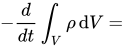


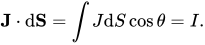
Thus, the conservation of electric charge, as expressed by the continuity equation, gives the result:

The charge transferred betwixt times and is obtained by integrating both sides:


where I is the internet outward current through a closed surface and q is the electric accuse contained within the volume divers by the surface.
Relativistic invariance [edit]
Bated from the backdrop described in manufactures near electromagnetism, accuse is a relativistic invariant. This means that any particle that has charge q has the same charge regardless of how fast it is travelling. This holding has been experimentally verified by showing that the accuse of 1 helium nucleus (two protons and ii neutrons bound together in a nucleus and moving around at high speeds) is the same as two deuterium nuclei (1 proton and one neutron bound together, simply moving much more slowly than they would if they were in a helium nucleus).[51] [52] [53]
See too [edit]
- SI electromagnetism units
- Color charge
- Partial accuse
References [edit]
- ^ a b "2018 CODATA Value: unproblematic charge". The NIST Reference on Constants, Units, and Doubtfulness. NIST. 20 May 2019. Retrieved 2019-05-20 .
- ^ Chabay, Ruth; Sherwood, Bruce (2015). Matter and interactions (4th ed.). Wiley. p. 867.
- ^ Chabay, Ruth; Sherwood, Bruce (2015). Affair and interactions (quaternary ed.). Wiley. p. 673.
- ^ Chabay, Ruth; Sherwood, Bruce (2015). Affair and interactions (4th ed.). Wiley. p. 942.
- ^ Rennie, Richard; Law, Jonathan, eds. (2019). "Quantum electrodynamics". A Dictionary of Physics (8th ed.). Oxford Academy Printing. ISBN9780198821472.
- ^ a b "CIPM, 1946: Resolution 2". BIPM.
- ^ International Agency of Weights and Measures (2006), The International System of Units (SI) (PDF) (eighth ed.), ISBN92-822-2213-6, archived (PDF) from the original on 2021-06-04, retrieved 2021-12-16 , p. 150
- ^ a b International Bureau of Weights and Measures (2019-05-twenty), SI Brochure: The International System of Units (SI) (PDF) (9th ed.), ISBN978-92-822-2272-0
{{citation}}: CS1 maint: url-status (link), p. 127 - ^ Gambhir, RS; Banerjee, D; Durgapal, MC (1993). Foundations of Physics, Vol. 2. New Delhi: Wiley Eastern Limited. p. 51. ISBN9788122405231 . Retrieved 10 October 2018.
- ^ Carron, Neal J. (21 May 2015). "Boom-boom of units: The evolution of units systems in classical electromagnetism". p. 5. arXiv:1506.01951 [physics.hist-ph].
- ^ Purcell, Edward One thousand.; Morin, David J. (2013). Electricity and Magnetism (third ed.). Cambridge University Press. p. 766. ISBN9781107014022.
- ^ Roller, Duane; Roller, D.H.D. (1954). The development of the concept of electrical charge: Electricity from the Greeks to Coulomb . Cambridge, MA: Harvard University Printing. p. i.
- ^ O'Grady, Patricia F. (2002). Thales of Miletus: The Beginnings of Western Science and Philosophy. Ashgate. p. 8. ISBN978-1351895378.
- ^ a b "Lives of the Eminent Philosophers by Diogenes Laërtius, Book 1, §24".
- ^ Roller, Duane; Roller, D.H.D. (1953). "The Prenatal History of Electrical Science". American Journal of Physics. 21 (5): 348. Bibcode:1953AmJPh..21..343R. doi:ten.1119/1.1933449.
- ^ Roller, Duane; Roller, D.H.D. (1953). "The Prenatal History of Electrical Science". American Journal of Physics. 21 (5): 351. Bibcode:1953AmJPh..21..343R. doi:10.1119/1.1933449.
- ^ Roller, Duane; Roller, D.H.D. (1953). "The Prenatal History of Electrical Science". American Journal of Physics. 21 (five): 353. Bibcode:1953AmJPh..21..343R. doi:x.1119/1.1933449.
- ^ a b Roller, Duane; Roller, D.H.D. (1953). "The Prenatal History of Electric Scientific discipline". American Journal of Physics. 21 (5): 356. Bibcode:1953AmJPh..21..343R. doi:10.1119/1.1933449.
- ^ Roche, J.J. (1998). The mathematics of measurement. London: The Athlone Press. p. 62. ISBN978-0387915814.
- ^ Roller, Duane; Roller, D.H.D. (1954). The development of the concept of electric charge: Electricity from the Greeks to Coulomb . Cambridge, MA: Harvard Academy Press. pp. half dozen–7.
Heilbron, J.L. (1979). Electricity in the 17th and 18th Centuries: A Study of Early Modern Physics. University of California Printing. p. 169. ISBN978-0-520-03478-five. - ^ Brother Potamian; Walsh, J.J. (1909). Makers of electricity. New York: Fordham University Press. p. 70.
- ^ Baigrie, Brian (2007). Electricity and magnetism: A historical perspective. Westport, CT: Greenwood Printing. p. 11.
- ^ Heathcote, Northward.H. de V. (1950). "Guericke'south sulphur globe". Annals of Science. 6 (3): 304. doi:ten.1080/00033795000201981.
Heilbron, J.L. (1979). Electricity in the 17th and 18th centuries: a study of early on Mod physics. University of California Press. pp. 215–218. ISBN0-520-03478-iii. - ^ a b Baigrie, Brian (2007). Electricity and magnetism: A historical perspective. Westport, CT: Greenwood Press. p. 20.
- ^ Baigrie, Brian (2007). Electricity and magnetism: A historical perspective. Westport, CT: Greenwood Press. p. 21.
- ^ a b Baigrie, Brian (2007). Electricity and magnetism: A historical perspective. Westport, CT: Greenwood Press. p. 27.
- ^ Baigrie, Brian (2007). Electricity and magnetism: A historical perspective. Westport, CT: Greenwood Press. p. 28.
- ^ Heilbron, J.L. (1979). Electricity in the 17th and 18th Centuries: A Study of Early Modern Physics. University of California Printing. p. 248. ISBN978-0-520-03478-5.
- ^ Baigrie, Brian (2007). Electricity and magnetism: A historical perspective. Westport, CT: Greenwood Press. p. 35.
- ^ Roller, Duane; Roller, D.H.D. (1954). The development of the concept of electric accuse: Electricity from the Greeks to Coulomb . Cambridge, MA: Harvard University Printing. p. xl.
- ^ Two Kinds of Electrical Fluid: Vitreous and Resinous – 1733. Charles François de Cisternay DuFay (1698–1739) Archived 2009-05-26 at the Wayback Auto. sparkmuseum.com
- ^ Wangsness, Roald K. (1986). Electromagnetic Fields (2d ed.). New York: Wiley. p. forty. ISBN0-471-81186-6.
- ^ Heilbron, J.50. (1979). Electricity in the 17th and 18th Centuries: A Study of Early Modern Physics. University of California Printing. pp. 280–289. ISBN978-0-520-03478-five.
- ^ Heilbron, John (2003). "Leyden jar and electrophore". In Heilbron, John (ed.). The Oxford Companion to the History of Modern Science. New York: Oxford Academy Press. p. 459. ISBN9780195112290.
- ^ a b Baigrie, Brian (2007). Electricity and magnetism: A historical perspective. Westport, CT: Greenwood Press. p. 38.
- ^ Guarnieri, Massimo (2014). "Electricity in the Age of Enligtenment". IEEE Industrial Electronics Mag. 8 (3): 61. doi:10.1109/MIE.2014.2335431. S2CID 34246664.
- ^ Franklin, Benjamin (1747-05-25). "Letter to Peter Collinson, May 25, 1747". Letter to Peter Collinson. Retrieved 2019-09-16 .
- ^ Watson, William (1748). "Some further inquiries into the nature and backdrop of electricity". Philosophical Transactions of the Royal Social club of London. 45: 100. doi:10.1098/rstl.1748.0004. S2CID 186207940.
- ^ a b Cohen, I. Bernard (1966). Franklin and Newton (reprint ed.). Cambridge, MA: Harvard University Press. pp. 390–413.
- ^ Weinberg, Steven (2003). The discovery of subatomic particles (rev ed.). Cambridge University Printing. p. xiii. ISBN9780521823517.
- ^ Heilbron, J.L. (1979). Electricity in the 17th and 18th centuries: a written report of early Modern physics. Academy of California Press. pp. 344–5. ISBN0-520-03478-3.
- ^ Tricker, R.A.R (1965). Early electrodynamics: The offset police of circulation . Oxford: Pergamon. p. 2. ISBN9781483185361.
- ^ Denker, John (2007). "One Kind of Charge". www.av8n.com/physics. Archived from the original on 2016-02-05.
- ^ Zangwill, Andrew (2013). Modern Electrodynamics. Cambridge University Press. p. 31. ISBN978-0-521-89697-9.
- ^ Faraday, Michael (1833). "Experimental researches in electricity — 3rd series". Philosophical Transactions of the Royal Social club of London. 123: 23–54. doi:ten.1098/rstl.1833.0006. S2CID 111157008.
- ^ Faraday, Michael (1838). "Experimental researches in electricity — eleventh serial". Philosophical Transactions of the Regal Society of London. 128: 4. doi:ten.1098/rstl.1838.0002. S2CID 116482065.
§1168
- ^ Steinle, Friedrich (2013). "Electromagnetism and field physics". In Buchwald, Jed Z.; Flim-flam, Robert (eds.). The Oxford Handbook of the history of physics. Oxford Academy Press. p. 560.
- ^ Faraday, Michael (1838). "Experimental researches in electricity — fourteenth series". Philosophical Transactions of the Royal Club of London. 128: 265–282. doi:10.1098/rstl.1838.0014. S2CID 109146507.
- ^ a b Buchwald, Jed Z. (2013). "Electrodynamics from Thomson and Maxwell to Hertz". In Buchwald, Jed Z.; Fox, Robert (eds.). The Oxford Handbook of the history of physics. Oxford Academy Printing. p. 575.
- ^ James Clerk Maxwell (1891) A Treatise on Electricity and Magnetism, pp. 32–33, Dover Publications
- ^ Jefimenko, O.D. (1999). "Relativistic invariance of electric accuse" (PDF). Zeitschrift für Naturforschung A. 54 (x–11): 637–644. Bibcode:1999ZNatA..54..637J. doi:10.1515/zna-1999-x-1113. S2CID 29149866. Retrieved 11 Apr 2018.
- ^ "How can nosotros testify accuse invariance under Lorentz Transformation?". physics.stackexchange.com . Retrieved 2018-03-27 .
- ^ Singal, A.One thousand. (1992). "On the accuse invariance and relativistic electric fields from a steady conduction current". Physics Letters A. 162 (2): 91–95. Bibcode:1992PhLA..162...91S. doi:10.1016/0375-9601(92)90982-R. ISSN 0375-9601.
External links [edit]
-
 Media related to Electric charge at Wikimedia Eatables
 - How fast does a charge decay?
Source: https://en.wikipedia.org/wiki/Electric_charge

Post a Comment for "a metallic coin is given a positive electric charge. what happens to its mass"